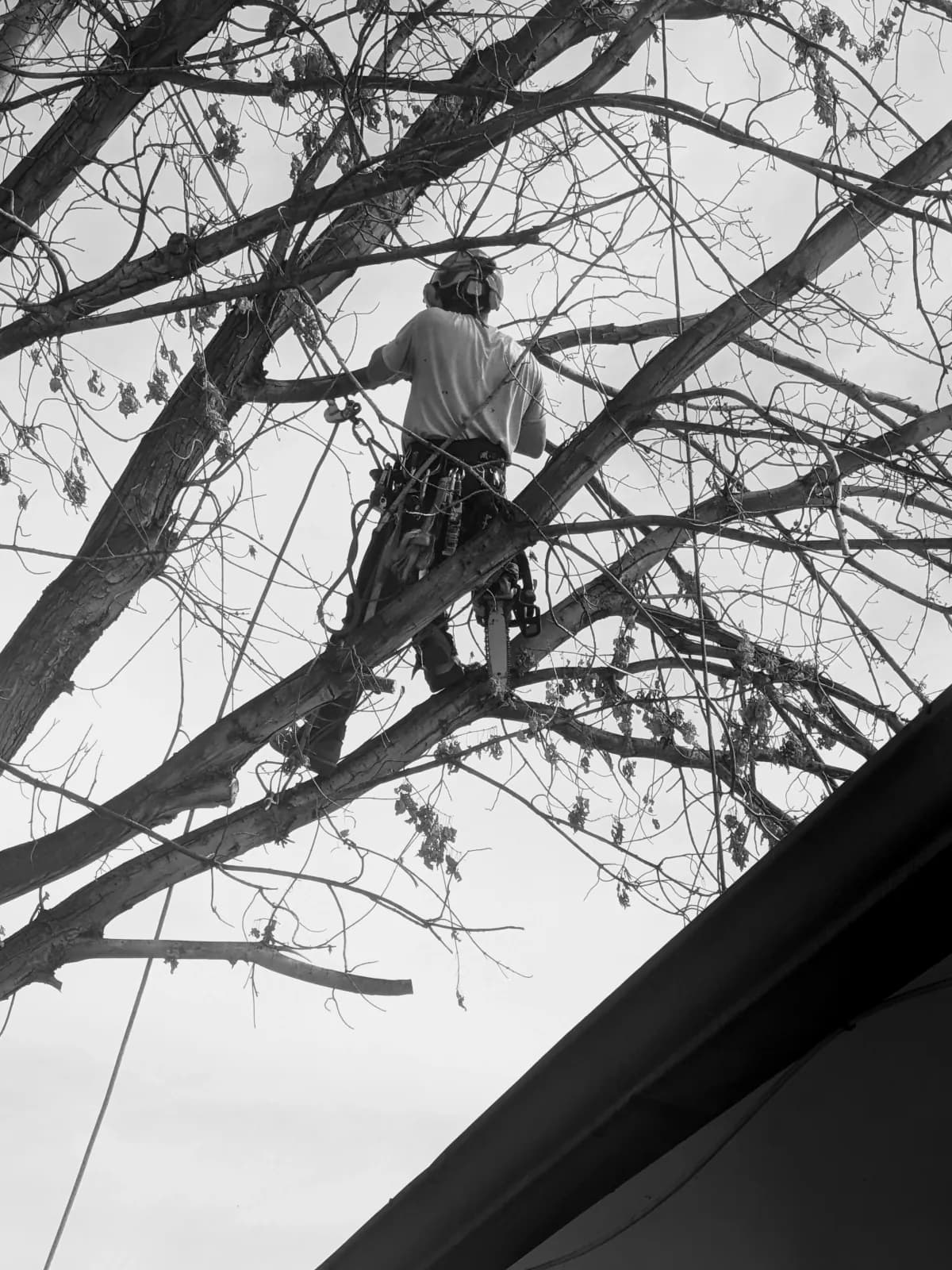
A mature tree is one of the most valuable things on a property, so the decision to remove one is never taken lightly. At the same time, a failing tree near a home, driveway or play area is a genuine safety concern, and waiting too long can turn a manageable job into an emergency.
The signs below are the ones we look at most often when assessing whether a tree can be kept or should be removed. One sign on its own does not always mean removal, but several together usually warrant a closer look from a professional.
1. Large dead branches or a dead section
Deadwood is normal in small amounts, but large dead limbs or an entire dead side of the canopy is a warning sign. Dead branches can fail without warning, and a tree that is losing major sections may be in decline. If more than a significant portion of the canopy is dead, removal often becomes the safer path.
2. A sudden lean with soil movement
Many trees lean slightly and have done so for years without issue. The concern is a new or worsening lean, especially when the soil at the base is lifting or cracking. That combination suggests the root plate is failing, which is one of the more serious structural problems a tree can have.
3. Deep cracks or splits in the trunk
Vertical cracks, seams and splits in the main trunk weaken the tree's structure. A trunk that has split, or where two main stems are pulling apart at a tight union, can fail suddenly under wind or snow load. Cracks paired with decay are especially concerning.
4. Fungal growth at the base
Mushrooms or conks growing at the base of the trunk or over the root zone can indicate internal decay. Because the damage is often hidden inside the wood, a tree can look full and healthy above while being compromised below. Persistent fungal growth is worth having assessed.
5. Extensive root damage
Roots anchor the tree and move water and nutrients. When roots are cut during construction, damaged by trenching or rotting from prolonged wet conditions, the tree loses stability and vigor. Since roots are underground, the signs often show up as thinning canopy, dieback or a developing lean.
6. Repeated limb failures
A tree that keeps dropping limbs, even in ordinary weather, is telling you something. Recurrent failures point to weak wood, poor structure or decline. Pruning can address some structural issues, but a pattern of failures may mean the tree has become unreliable.
7. The wrong tree in the wrong place
Sometimes a tree is healthy but simply in a problematic spot, such as directly over a foundation, tangled in a power line corridor or crowding a structure it will only grow further into. In those cases removal may be a practical decision rather than a health one.
When in doubt, get it assessed
The safest approach is to have a professional look at the tree before deciding. An assessment can distinguish between a tree that needs removal and one that can be saved with proper pruning or a support system. If you are seeing several of these signs on a tree in the Grand Junction area, reach out for a free estimate and we will take a look.
What homeowners should inspect first
If a tree is worrying you, start with the simplest clues. Look for a sudden lean, fresh cracking, large dead limbs or mushrooms near the base. Then check the area around the tree for lifted soil, exposed roots or changes that happened after a storm or construction project. The goal is not to diagnose the tree yourself, but to notice whether the problem is isolated or part of a larger pattern.
Pay attention to what the tree sits over as well. A defect that would be low risk in an open field can become urgent when the same tree is over a roof, driveway, play area or parking space. That target matters as much as the defect itself. A tree may stay standing for a while and still be the wrong tree to leave in that location.
When removal becomes the safer choice
Removal is usually the right conversation when several warning signs show up together or when the tree has already lost too much structure to recover. Large dead sections, repeated limb failures, trunk cracks and active root movement can all point to a tree that is no longer dependable. A single issue may be manageable. Multiple issues often are not.
The decision is rarely about looks alone. It is about whether the tree can continue to stand safely where it is, especially through wind, snow and seasonal stress. If the answer is no, removal may protect the property better than repeated repairs or short-term fixes. That does not mean every suspicious tree needs to go. It means the tree needs to be judged on the total picture.
When another service may be better
Sometimes a tree is not failing so much as poorly managed. A healthy canopy that is crowding a roof can often be handled with trimming. A tree with a structural weakness may be a candidate for pruning or cabling. A tree that looks risky but does not yet show enough defects for removal may benefit from a proper risk assessment first.
That distinction matters because the right service can preserve a tree that still has value. If you are unsure, ask for an honest look before you assume removal is inevitable. Our goal is to recommend the service that actually fits the tree and the property, not the one that sounds most dramatic.