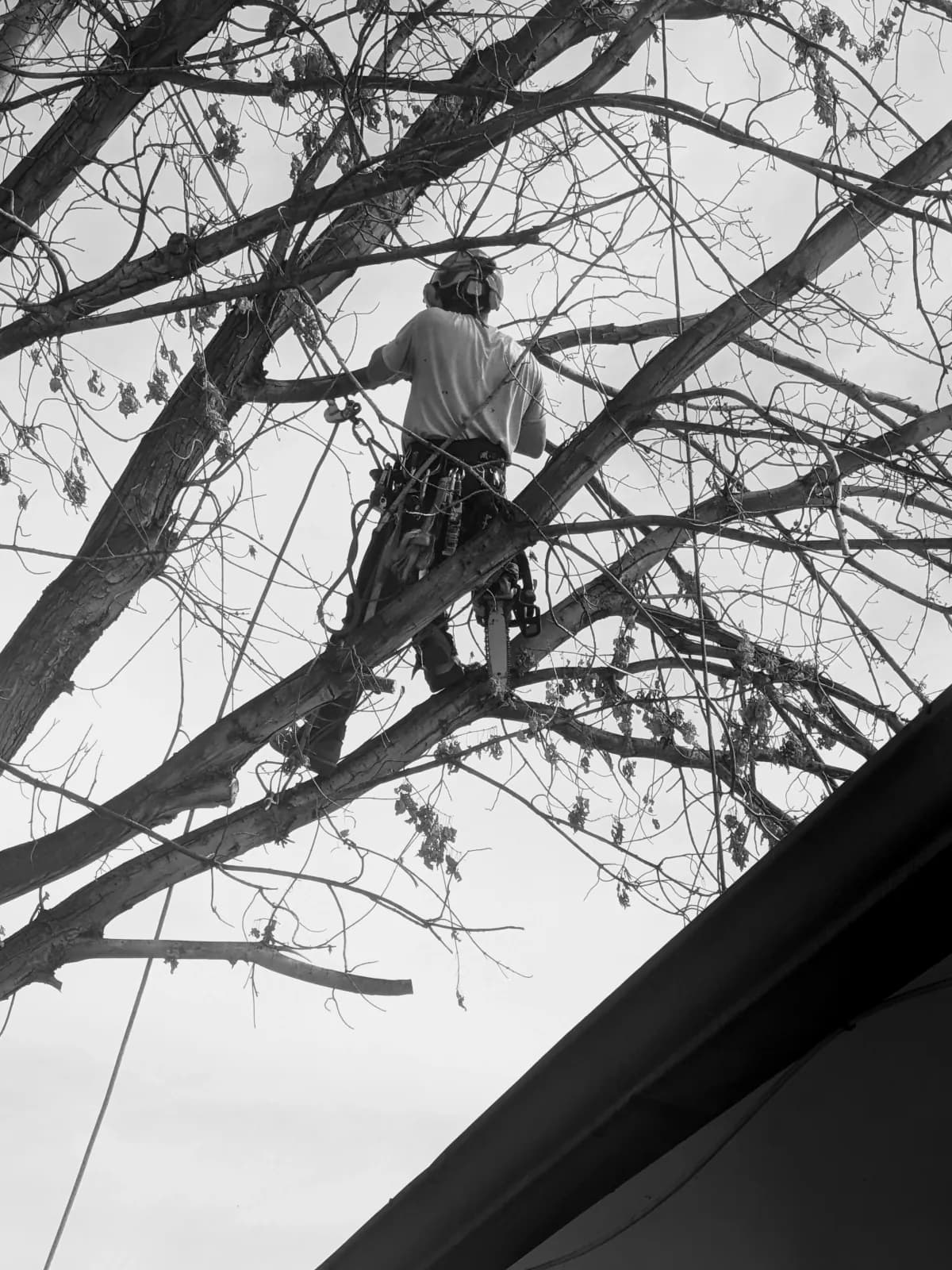
Some trees raise real safety concerns: a large tree leaning toward a house, a trunk with visible decay, or a limb overhanging a play area. A tree risk assessment is a structured way to evaluate these trees and understand the level of risk they pose.
Rather than guessing, we look systematically at the tree's condition, structure, surroundings and the targets that could be affected by a failure. From there we can lay out practical options, from monitoring to pruning to removal.
An assessment helps you make a confident, informed decision instead of either ignoring a hazard or removing a tree unnecessarily.
What to Expect
A risk assessment is appropriate when a tree has visible defects, unusual lean, dead sections, decay, root damage or a history of storm stress. Before work begins, we examine the tree and the surroundings together, because risk is always a combination of tree condition and what could be hit if it fails. That broader view helps separate a tree that simply looks concerning from one that truly needs intervention.
The assessment can lead to monitoring, pruning, cabling, bracing or removal depending on what the evidence shows. We do not promise that every risky tree can be saved and we do not overstate what support systems can do. If a tree is located near a structure or a high-value target, the recommendation may be different than it would be in an open space. Access, visibility and the ability to safely inspect the tree all affect the quality of the evaluation.
Customers across Grand Junction and the Grand Valley can expect a plain-language explanation of what we saw and why it matters. If the better fit is certified arborist input, emergency service or planned removal, we will say so. Free estimates are available, and the goal is to leave you with a practical next step.
A good assessment should also help you separate urgency from nuisance. A dead limb over a driveway may need prompt action, while a cavity in a tree over an open lawn may simply need monitoring. We will talk through the degree of concern, the likely consequences of inaction and the options that match the actual situation so the recommendation is useful rather than alarmist.
When the situation is borderline, the details matter. A tree with a lean can be stable for years or can be moving toward failure, depending on root condition and the target below it. An assessment gives you a structured way to decide what is actually happening instead of relying on guesswork, which is where people often either overreact or wait too long.
What's Included
- Systematic evaluation of tree condition
- Assessment of structural defects
- Consideration of targets and surroundings
- Clear explanation of risk factors
- Practical options for reducing risk
- Honest recommendation on next steps
Our Process
- 1
Examine the tree
We inspect the trunk, canopy, roots and base for defects and signs of instability.
- 2
Consider the targets
We look at what could be affected if the tree or a limb failed.
- 3
Weigh the risk
We combine condition and targets to describe the level of risk clearly.
- 4
Present options
We lay out practical steps, from monitoring to mitigation to removal.
Why Choose Top Notch Trees
Clarity on real risk
You learn whether a tree is truly hazardous or simply looks concerning.
Avoid over-removal
Assessment can reveal that a tree is safer to keep than to remove.
Practical options
We focus on actionable ways to reduce risk, not just worst-case outcomes.
Clear next steps
You can make decisions about your trees with confidence.
If a tree on your property worries you, do not wait. Contact us for a free estimate and we will assess the tree and give you clear, practical options.